Be a window

But God shines his light through us

Matthew 5:16 Let your good deeds shine out for all to see, so that everyone will praise your heavenly Father.

Hebrews 13:21 May the God of peace equip you with all you need for doing his will. May he produce in you, through the power of Jesus Christ, every good thing that is pleasing to him.

Last year, our church sent to be cleaned several of the stained-glass windows of our historic building. The difference is stunning, to the point that I’m sometimes distracted from the service by the play of colored light on the huge painting of Jesus’ ascension above the altar. I find this enriching, because I know what those windows convey of the Gospel story.
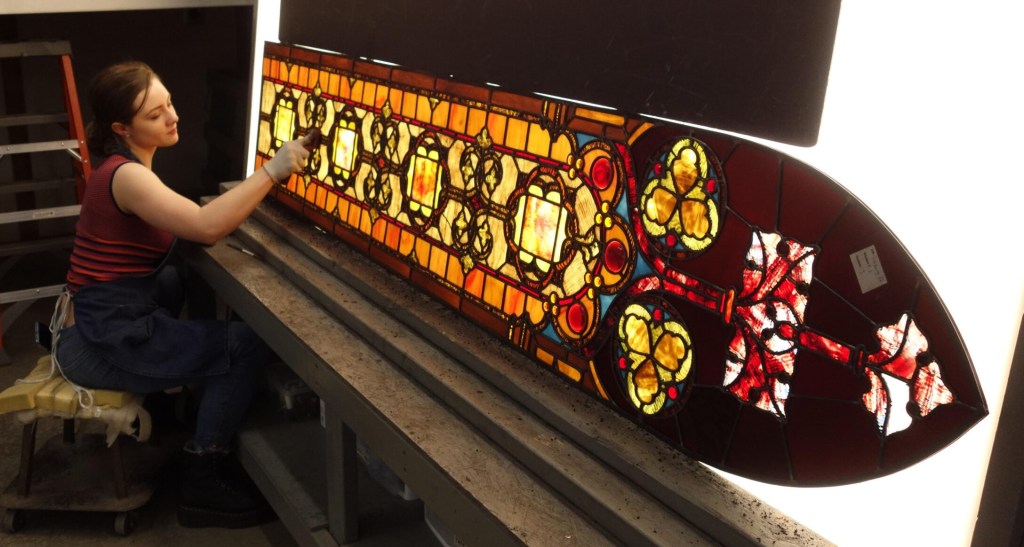
Cleaning of one of the smaller Ascension windows: photo Marilyn Chislaghi

I know too the passion and prayer of the church to not only receive light through its beautiful windows, but to reflect light into its cosmopolitan neighborhood of Oakland, which attracts people from around the world through its universities and medical center (including us from our beloved Brazil!).

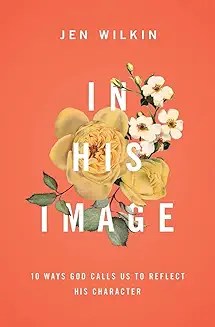
Hence my appreciation of George Herbert’s poem “The Window,” which I’m connecting to chapter 3, “God Most Good,” in the book In His Image I’ve been referencing. Jen Wilkins says “Be good. Others will see it. You’ll be a light causing others to glorify the Father of lights.” Here’s the poem:

The Windows

Lord, how can man preach thy eternal word?

He is a brittle crazy glass;

Yet in thy temple thou dost him afford

This glorious and transcendent place,

To be a window, through thy grace.

But when thou dost anneal in glass thy story,

Making thy life to shine within

The holy preachers, then the light and glory

More reverend grows, and more doth win;

Which else shows waterish, bleak, and thin.

Doctrine and life, colors and light, in one

When they combine and mingle, bring

A strong regard and awe; but speech alone

Doth vanish like a flaring thing,

And in the ear, not conscience, ring.

George Herbert, 1593-1633

How clean is the beautiful window of my redeemed life?

Our great Ebenezer

But God faithfully keeps his word

Hebrews 2:17 Therefore, it was necessary for him [Jesus] to be made in every respect like us, his brothers and sisters, so that he could be our merciful and faithful High Priest before God.

John 1:14 So the Word became human and made his home among us. He was full of unfailing love and faithfulness.

In Chapter 7 of her book In His Image, Jen Wilkin identifies the written word of God, the Bible, as “our great Ebenezer, a memorial stone to the faithfulness of God. … Between its covers a glorious truth is repeated for our great benefit: God is worthy of our trust” (pages 100-101).

What does she mean by calling the Bible a “great Ebenezer”? 1 Samuel 7:12 says, “Samuel then took a large stone and placed it between the towns of Mizpah and Jeshanah. He named it Ebenezer (which means “the stone of help”), for he said, “Up to this point the Lord has helped us!” Samuel did this to memorialize a time when God intervened with a mighty thunderstorm to save his people from an invading army.

The Bible is full of wonderful “But God” stories of God’s faithfulness, to encourage us in our own hard times. Jen continues, “When we spend time in the Bible, our lives begin to bear witness to its faithful message. We ourselves become stones of remembrance for those around us, giving faithful testimony that God is worthy of our trust, no matter what (page 101).

Yesterday, Dave showed me this picture of fifty pastors and leaders in Venezuela who had just been gifted with the Biblia de Estudio para el Discipulado (Discipleship Bible).

The picture triggered a memory of God’s faithfulness to Dave. For six years after Karis and I came to Pittsburgh for intestinal transplant, Dave and I lived on two different continents, always expecting Karis to get well enough for me to go home to Brazil. Finally, Dave realized Karis wasn’t going to get better, so he needed to move to Pittsburgh.

This felt to Dave like a punch in the gut. He was 100% engaged in ministry in Brazil. What would he do in Pittsburgh? Yet in agony of spirit, he took the necessary steps over the next year to obey what he knew God was asking him to do: give up Brazil and join Karis and me here.

But God had a plan. The week before he left São Paulo, Dave received a call from the Brazilian Bible Society asking him to write a Discipleship Bible in Portuguese.

Had Dave stayed in Brazil, he would never have found the time to write. In Pittsburgh, though, this work became his great joy, an eight-year project into which he could pour all that God had planted in him about being and making disciples of Jesus: 450 small group studies, notes for disciples of Jesus on every page, highlighting practical applications, introductions to each book noting what it had to offer disciplers, and a comprehensive index and cross-reference system.

The Discipleship Bible was published in 2018 in Brazil, and last year in Spanish, in multiple printings already.

Dave was faithful to what he understood God was telling him to do, though the cost to him was great. God was faithful in giving Dave a project he could work on in the “foreign land” of Pittsburgh. All so people across Latin America and Brazil who want to walk closely with Jesus, open themselves to transformation by his Word, and help others do this also, could have access to the years of experience and all the passion and wisdom about disciplemaking God had poured into Dave across his lifetime.  

What tough thing is God asking of you? Can you trust his faithfulness, even though you can’t yet see it?

All the Lord does is just and good,
    and all his commandments are trustworthy.
 They are forever true,
    to be obeyed faithfully and with integrity.

Psalm 111:7-8

Celebrating Roots, by Sue Long Hammack, Richmond, VA

But God had other plans: He knew what lay under the desert land

Ephesians 3:17 Christ will make his home in your hearts as you trust in him. Your roots will grow down into God’s love and keep you strong.

Hebrews 10:24 Let us think of ways to motivate one another to acts of love and good works.

I (Debbie) was fascinated by the story my Wheaton College classmate Sue Long told in their last newsletter and am excited to share it with you. It coordinates with the “God Most Loving” chapter in Jen Wilkin’s book, In His Image, which calls us to agape love like God’s: holy, infinite, and costly. “For agape, there is no such category as “unlovable” (page 41).

Here’s Sue:

SIM (at that time Sudan Interior Mission; now SIM International) entered Niger in 1924. Terry and I and my brother Jack will return to Niger in December to celebrate this centennial. SIM’s initial work concentrated on trekking and nomadic outreach. After a decade, SIM asked the French government in Niger for property to establish a surgical hospital among the poorest of the poor in the vast rural areas of the Sahara Sahel. Finally, following 15 years of vigorous discussion, the French ceded to SIM what looked like a wasteland on which to build. It seemed a mockery: “You can try, but you won’t succeed.” But God had other plans!

In July 1950, after a year of French study in Paris, Sue’s parents, Dr. Burt and Ruth Long, landed on a desolate stretch of runway, having leapfrogged across the mighty Sahara Desert to this isolated destination. With two young sons in tow, they reached their new home in a small village scalding in the heat of brilliant sunshine. They would add four more children to the family over the next years.

The village was called Galmi, located far from anywhere, with scrubby bushes, hard, stony ground, lonely thorn (acacia) trees upon which camels chewed, no electricity, and limited water. And HOT. Burt and Ruth had agreed to open the hospital in Galmi as a channel for the gospel and a beacon of hope in a seemingly godforsaken place. Thousands of people lived in scattered villages of the Sahel with no access to medical help and no knowledge of a Savior who offers forgiveness of sins and eternal salvation.


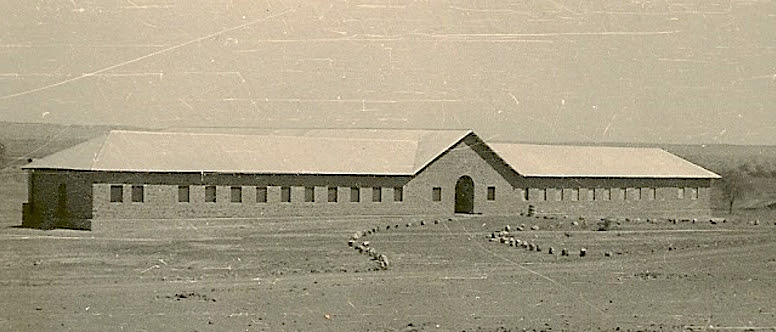
Others had come before them. Two houses and a few other buildings, built with rocks, mud, cement, and tin-pan roofs stood ready to receive the first permanent mission workers. Way down the path from the houses stood the completely empty T-shaped hospital, with cement floors and metal shutters over screened windows.

Galmi became an oasis in the desert after a lake of water was discovered under the property in 1980. God knew the value of the French gift!

You can read the rest of the story in A Family Living under the Sahara Sun, by Sue’s mother Ruth Long, available on Amazon.

Debbie: I’ve just ordered the book. Imagine those thirty years of faithful love and service by the Long family before the underground lake was discovered. Sue says her roots grew down deep into Galmi’s hard soil. Even there, she discovered God’s wonderful love, which propelled her and her husband Terry into a lifetime of service in Nigeria.

Does the soil of your heart feel hard? Your roots growing into his love will make you strong.

Blessings by Laura Story

Role-modeling graciousness

But God is gracious

Hebrews 4:16 So let us come boldly to the throne of our gracious God. There we will receive his mercy, and we will find grace to help us when we need it most.

Colossians 4:6 Let your conversation be gracious and attractive.

Between travel and illness, I haven’t managed to post for the last couple of weeks. If you’ve been tracking, though, you know I’ve been studying the book of Hebrews. I’m also reading Jen Wilken’s In His Image: Ten Ways God Calls Us to Reflect His Character. I intend to use Jen’s categories over the next few weeks, probably in the order she presents them.

Yesterday, though, I was impressed so much by Kamala Harris’s concession speech that I decided to skip ahead to Jen’s chapter 6: God Most Gracious. I’m not good at it yet, but I want to become a gracious person. I’m always on the lookout for role models in “real life,” people who can show me what being gracious looks like. So, Kamala’s speech and attitude and manner caught my attention.

No matter who you voted for, I think you can profit from taking twelve minutes to watch this:

I’ve done so three times already and will probably watch it again.

Graciousness requires humility. It requires caring more about others than about oneself. As Jen says, what people tend to want is not to be treated fairly, but to be treated preferentially. Our love of preferential treatment displays itself in a thousand ways, wanting the best for ourselves. But,

“Christians should have a reputation for playing favorites with everyone except ourselves. As those who have received abundant grace, we do good in abundance. … We should be known as the people who respond to ‘I hate you’ with ‘I love you,’ and as the people who respond to ‘I love you’ with ‘I love you more’” (pages 94-95).

Do everything without grumbling or arguing, so that you may become blameless and pure, children of God without fault in a warped and crooked generation. Then you will shine among them like stars in the sky as you hold firmly to the word of life (Philippians 2:14-16).