
But God asks us to decide without pressure
2 Corinthians 9:5-8 But I want it [the Corinthians’ gift to the needy church of Jerusalem] to be a willing gift, not one given grudgingly. … You must each decide in your heart how much to give. Don’t give reluctantly or in response to pressure. … And God will generously provide all you need. Then you will always have everything you need and plenty left over to share with others.
2 Corinthians 8:12-13 Whatever you give is acceptable if you give it eagerly. And give according to what you have, not what you don’t have. Of course, I don’t mean your giving should make life easy for others and hard for yourselves.
“Work harder.” “Give more.” “Give until it hurts.”
Does that sound like God’s voice?
Sometime, maybe so. Paul commends the Macedonian church: “I can testify that they gave not only what they could afford, but far more” (8:3). He hastens to say, though that they did it joyfully, of their own free will. Not because of manipulation or pressure or guilt.
When famine hit the church in Jerusalem, Paul asked for aid from believers who had more at that time. He encouraged the Corinthians to consider a donation, saying “I only mean that there should be some equality. Right now, you have plenty and can help those who are in need. Later, they will have plenty and can share with you when you need it” (8:13-14).
I grew up in a small Mayan village in Guatemala where people lived at “subsistence” level. Our family lived humbly by North American standards—a family of ten in a house with two bedrooms (once Dad set up his study in the garage so he and Mom could move out of the living room), for which Dad paid $25/month rent, out of our $200 missionary income. We had books, and a few toys and games, and a small refrigerator. By comparison with our neighbors, we were wealthy, and our family generously shared what we had, receiving so much more in return of friendship and richness of culture and place.
When I came to the U.S. on furloughs as a child, I was overwhelmed by the extravagance of all that I saw around me. I struggled deeply with the question, “How can people live like this, when so many in the world barely have enough to eat?” I felt an obligation to work hard, to meet not just my own simple needs but to share with others. I gave sometimes from nothing, skipping meals to make up what lacked, and it was a joy to do so. Money has never caused me anxiety. I see this as a gift from God that has eased tensions when, for example, Dave and I struggled to make ends meet. I found it easy to believe God would provide what we needed financially. And we could always cut back, whether with groceries or in other ways.
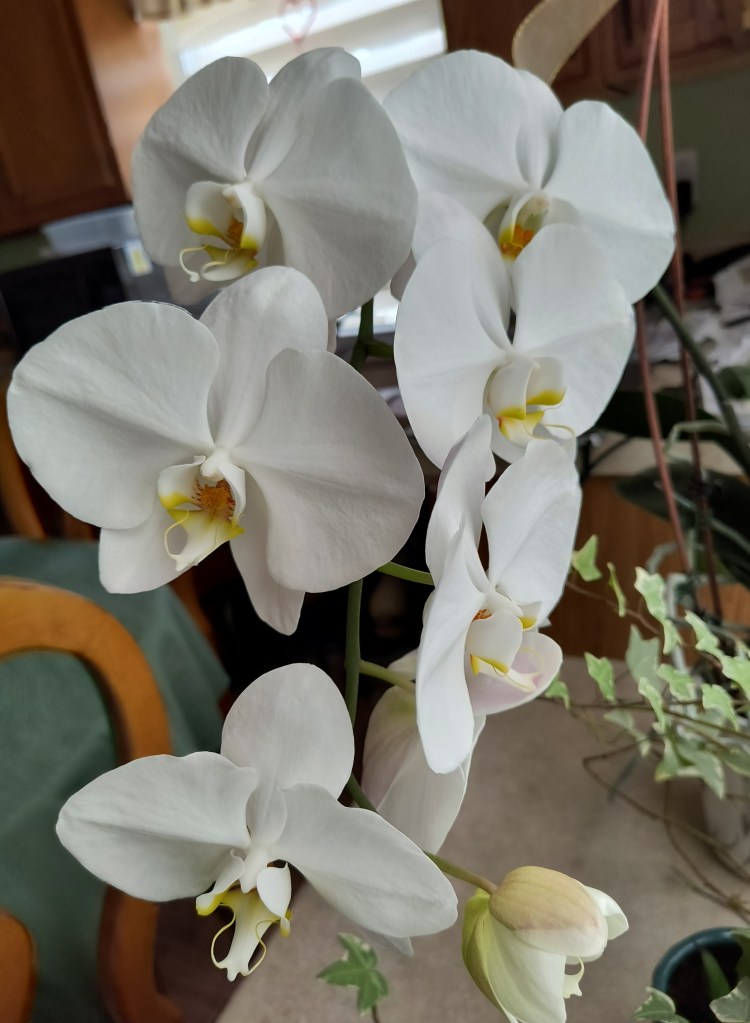
On June 4 there were just two blossoms. God’s generosity blooms right in front of me.
It’s taken me a lifetime, though, to understand that saying “no” to service—the overextension of another kind of giving, my time and energy—can be an act of faith. Saying no acknowledges my smallness and God’s bigness; my creaturely limitations. Can I trust God to care for others through different means and people when my own resources—including emotional ones—have run dry? When I just want to crawl in a hole for a while and hide? Can I acknowledge my own needs for rest as being legitimate? That has been a much bigger struggle, and of course there’s more to it than what I’ve said here.
I’m sure I’ve made mistakes trying to live out this kind of faith, when obedience actually means saying no. Sometimes I’ve given when I shouldn’t have. Sometimes I haven’t when I should have, missing out on the special joy of sharing what God has given me.
In both cases, though, God’s love is bigger than my poor powers of discernment. Would God care for the people of Jerusalem some other way if the Corinthians pulled back on what they had promised to give? What do you think? I would love to know!!
I admire caring people who can take a careful look at their own situation and decide without guilt or self-recrimination to trust God with a given circumstance. Especially when I see them at other times give generously with enthusiasm and joy. They don’t think they have to respond to every need that comes their way. Yet they love to share when they can, when God has blessed them with more than they need. I see these people living simply, stewarding their resources because they so delight in giving to others.
Paul says two things result when we give in this way: people’s needs are met (sometimes through me; more often through others), and God receives praise (9:12). Later, he also says that the recipients of the gift will pray for the giver with deep affection. It’s a win-win; “overflowing grace” in both directions (9:14). I’m still learning to practice this grace-filled way of living.
P.S. I really would love to know your thoughts on my question a couple paragraphs back!
Goodness of God, by Hillsong
 Debra Kornfield