A great light, with Margaret Daly, San Diego

But God lifts our heavy burdens

Isaiah 9:2, 4 The people who walk in darkness will see a great light. For those who live in a land of deep darkness, a light will shine. … For you will break the yoke of their slavery and lift the heavy burden from their shoulders.

I was born and grew up in Guatemala. My parents worked with Wycliffe Bible Translators, who used the name Summer Institute of Linguistics (Instituto Lingüístico de Verano, ILV below) for their educational contracts with Latin American governments. Their work included analyzing the linguistic structure and creating an alphabet and literacy materials for languages not previously written. My mom, for example, created primers for teaching people to read, and trained trainers to teach others to read.

Dad devoted his time to translating the Scriptures into Maya Ixil. He told fascinating stories about the translation process. One of my favorites was about translating 1 Peter 5:7. It illustrates, I think, the beauty and significance of the mosaic described below.

Dad told us he made an initial translation of 1 Peter 5:7, “Give all your worries and cares to God, for he cares about you,” and read it to his Ixil assistant. The man said, “Oh no, you can’t say that.” Dad tried a series of different words until he had exhausted his Ixil vocabulary, each time receiving the same response.

Finally, he returned to his original rendition and asked, “If I were to say this, what would it mean?”

His assistant replied, “Why, it would mean that God cares about us. That’s not possible!”

Dad said, “But that is exactly what this text is telling us.”

The man’s eyes grew wide. Then he leaned back and laughed and laughed and laughed.

All his life he had been terrified of God and of the spirits that inhabited every aspect of nature. They were not benign or personal. He and his family spent much of their resources on trying to make the spirits happy enough to simply leave them alone.

The idea that God cared – about him! – was revolutionary. This Scripture literally transformed his life. He later told my parents, “This Word has made me sweet inside.”

When I was fourteen, I lived with my parents and youngest sister at a Wycliffe base in Ixmiquilpan, north of Mexico City. Occasionally we visited the ILV Tlalpan center in Mexico City. I loved gazing at a huge three-story mosaic on the side of the main administration building. It illustrated Isaiah 9:2 and helped me appreciate my parents’ work.
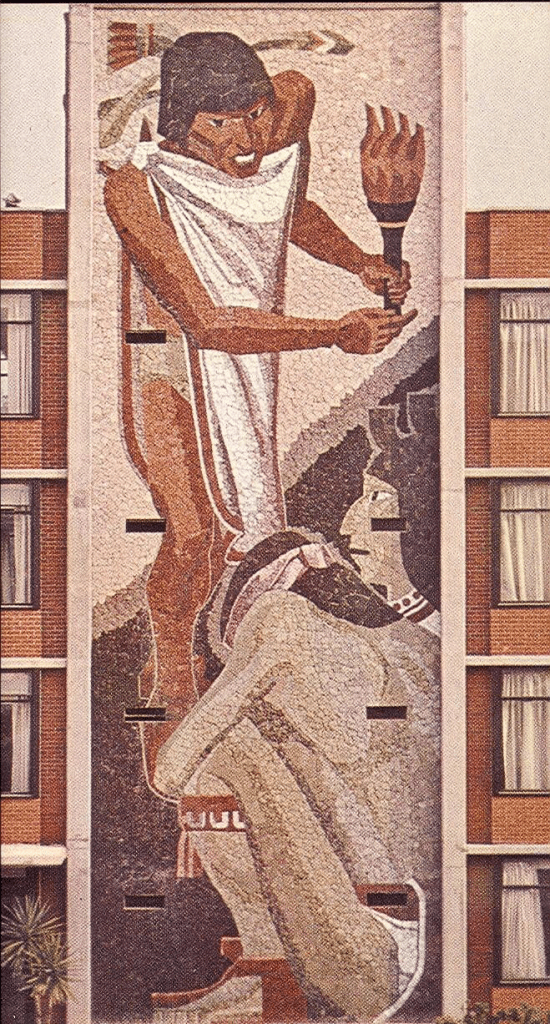
“The teaching of your Word gives light” (Psalm 119:130)

I asked veteran Wycliffe translator Margaret Daly, retired from her work in Mexico, to describe this amazing mosaic for us:

“Thinking about Isaiah 9:2 and the stone mosaic on the former ILV office building in Tlalpan, I guess you are not so much interested to know how Katie Voigtlander came up with the concept and the various aspects of the construction of the mural as you are with the connection between what is pictured and the translation work of ILV.  Am I right?”

“Yes. Thank you, Margaret.”

“As I recall, Katie wanted the mural to show how the introduction of the gospel message in languages the people understood brought them from spiritual darkness into the light of life in Christ. Note that the figure at the bottom has its head lowered and shoulders bowed, indicating a lack of interest. The figure in the middle has his head raised, indicating interest has been aroused because what is being told is understandable. The figure at the top is carrying a torch to light the way to truth for his fellow man. The lighted torch symbolizes the translated Scripture.

“The mural is not a painting — Katie went to the quarry and chose the colored stones to be used. A three story ‘tablet’ was formed on which the ‘cartoon’ (the enlarged drawing of Katie’s concept) was carefully traced so that she could see how it all fit together, make any necessary changes in perspective, and finally follow the cartoon in placing the stones.”

(Me) “I read an article in Spanish that identifies eight colors and types of stones used in the mosaic.”

“Yes. I’m sending you another article too that tells more about Katie’s intent and process.”

[If you’re interested, you can read the article below.]

“To transfer the cartoon to the tablet, Ted Engel, one of the Swiss ILV members who was a trained mountaineer, lowered himself from the roof of the building. Katie climbed the scaffolding daily for several months to work with the stone masons.”

(Me) “The Tlalpan mosaic honors the work you and your husband John devoted your lives to accomplish, Margaret. Thanks so much for helping us better understand the impact of Bible translation through Katie’s stunning mural.”
(Margaret, quoting Marilyn NIckel Ahrens Baer):”I found the following article when I was working in the Mexico-Cardenas Museum at JAARS***. We were also given, by the Mexico Branch, the original drawing that Katie made before the mosaic was created.”

The Mural on San Fernando Avenue

Reported by Carlos Zugasti, resident of the Barrio del Niño Jesús, Tlalpan

This mosaic mural, full of mythological symbolism, is in the tradition and style of Mexican murals, and in this case has the aura of primitive civilization. Mexico is no stranger to this tradition. Long before any contact with peoples from other latitudes, people here designed and built mosaic murals; the ancient Aztecs practiced this art of painting with pieces of stone. They created mosaics on objects destined to propitiate their many gods and by which they represented ritually the equilibrium of the cosmos. They displayed on masks, earrings, medallions, knives and necklaces scenes of importance for religion, history or everyday life relating to education and culture. In Mexico the history of mosaic art cannot be reduced to a simple chronicle of decoration for rooms or for educational buildings. It is a compendium of the art produced with great dedication and talent during the Aztec dynasty by artists of world class ability.

Tlalpan has various examples of mosaic art, some done in stone and some in glass. With pride we focus on the one found on San Fernando Avenue, between the Viaducto to Cuernavaca and Retama Street, in the Barrio del Niño Jesús, on the building which now belongs to the Centro Nacional de Cancerología.The mural was created under the auspices of the Instituto Lingüístico de Verano, A.C., which in its time was charged with the task of designing phonemic alphabets for Indian Languages of Mexico and which was a pioneer in the elaboration of dictionaries for these languages.

During her long career, the Mexican linguist Artemisa Echegoyen* compiled a dictionary of the Otomi language of the Sierra, and published oral histories of the Mexican Revolution in the journal Tlalocan. She collaborated in the translation to Otomi of the Gospel of Saint John and also wrote articles about the indigenous culture. In collaboration with Katherine Voigtlander** she published the grammar “Luces Contemporaneas del Otomi,” and prepared many other linguistic studies as well as promoting and publishing literature in Indian languages.

Katherine is the one who designed and executed this mural, utilizing natural stones of different colors and hues. She brought together Venician red, sienna, rose, salmon, grey, obsidian black, Calcedonian white (like marble) and Tikal green. With them she created a mural measuring almost 38 square meters that covers part of the headquarters building of the old Linguistic Institute. The theme of the mosaic is an Indian man carrying a torch to illuminate the darkness. Katherine Voigtlander executed the work with regular “teselas”, stones selected and cut to the desired shape. The colors of the minerals in these natural stones became part of the artwork of the mural which covers three stories of the building which housed the library and classrooms as well as administrative offices of ILV.

Cata, as we all knew her, in addition to her linguistic expertise, had unique abilities for drawing and painting. She illustrated many of the manuals, missals, booklets and dictionaries in Mexican Indian languages. With her great artistic sensibility, she designed the mural, learned the technology for building a mosaic mural, and produced a great work of art, worthy of wide recognition. She has left for posterity this monument in stone that in its time was symbolic of the work of the Summer Institute of Linguistics. It forms part of the Route of Murals that includes those of the National University of Mexico executed by Diego Rivera, David Siquieros, Juan O’Gorman and the mosaic murals we see in the Anahuacalli of Coyoacán.

*Artemisa Echegoyen passed away Febuary 11, 2006.

**Katherine Voigtlander moved to Arizona; she celebrated her 90th birthday April 19, 2007. She died August 13, 2011.

***JAARS, Jungle Aviation and Radio Service, was founded by Cameron Townsend (who also founded Wycliffe) 75 years ago to assist Bible translators living in remote areas with transportation and radio connection. Margaret’s son Charles Daly (Chuck) has worked with JAARS his entire career. See https://www.jaars.org/about/.


Don’t think like everyone else

But God is the one we should fear

Isaiah 8:11-13 The Lord has given me a strong warning not to think like everyone else does. He said, “Don’t call everything a conspiracy, like they do, and don’t live in dread of what frightens them. Make the Lord of Heaven’s Armies holy in your life. He is the one you should fear.”

Romans 12:16-21 Live in harmony with each other. And don’t think you know it all! … If your enemies are hungry, feed them. If they are thirsty, give them something to drink. … Don’t let evil conquer you, but conquer evil by doing good.

I had a wonderful experience on our recent 1500-mile trip to visit friends and mission supporters west of us. We stopped to visit a friend we haven’t seen in many years. He brought up a political issue that is very important to him, asking what we thought about it. As carefully as I could, I expressed agreement while saying that for me there were other important issues to consider as well. He listened. He did not immediately dismiss or diss me. His expression of affection for me did not waver.

I felt honored by this friend. Rather than “cancelling” me because I didn’t agree with him 100% about one-issue voting–a heartbreak I’ve experienced before–he noted how much we have in common. He protected our relationship rather than negating all that we’ve witnessed together of the Lord’s work in our lives.

Shutterstock: fizkes

The times I have felt dishonor, once the sting wore off, I have wondered whether fear might be at the root of cancelling or ghosting a friend over something so relatively unimportant to me (maybe because I didn’t grow up in this country?) as political issues. Certainly, the media can foster fear in us, especially if we pay attention only to one perspective on a given issue or decide certain political figures are wearing the white hats and the rest are black, along with everyone who gives them a hearing. Fear can result in rejection of those we’re told are destroying what we value. It can leave us vulnerable to believing things that are simply not true. It can narrow our experience of life, to the point that we miss out on abundance and the freedom to live joyfully.

But the Lord calls us to think and act differently. When our trust is solidly rooted in him and his sovereignty over history, we don’t have to live in fear. We can dare to honor others, as our friend did on our delightful visit with him and his family.

Elaine Elliott, who has contributed to this blog in the past, recently sent me notes from an online sermon on honor she listened to. She’s referencing one of the values of the church she and her husband attend in Antigua, Guatemala:

Here’s the value: “We give honor—to those we lead, work beside and follow. The cross gives every human being immeasurable worth. We will treat people with the honor the cross displays.” 

Dishonor disrupts the supernatural. The Greek word for dishonor means “to treat as common.” Honor is mentioned 147 times in Scripture—usually in reference to people. The word means to value, to treat as precious, to give weight. 

Honor creates a space for the Holy Spirit to be released. Honor must be chosen; it is not a feeling but a choice. 

All honor starts with honoring God. God says, “Those who honor me, I will honor” (1 Samuel 2:30). God LOVES the world–and calls us to consider precious what he does, the sinners–including you and me–for whom Jesus died.

Some ways we can choose to honor others: not compare, make it a daily habit, practice gratitude. Daily think of something positive about your spouse and friends, for example, and share it with them. Each day think of something you can be grateful for about someone with whom you’re in a struggle and share it with them. Speak words of honor over your home, declaring your spiritual purpose. One purpose: “I love my husband. I will make him glad he married me.”

Romans 12:9-10 says, “Don’t just pretend to love others. Really love them … with genuine affection. Take delight in honoring each other” (NLT). “Outdo one another in showing honor” (RSV).

Respect is earned; honor is a gift. If someone is dishonoring you and you honor them, you have already won the competition by outdoing them! If your effort is sincere and heartfelt, it has value even if the other person is not able to receive it as intended. It’s a kind of defense against bitterness and anger when we are misunderstood and mistreated.

Thank you, Elaine! While recognizing the complexity culturally, relationally, and emotionally of what is perceived as honor or dishonor, I think these ideas–and the example of my friend–can help us think and act more like Jesus would in our challenging culture.

Lament

My apologies for posting this out of order! I wrote it before traveling, so it would be easy to post on the run, and then forgot I never did it.

But God wants us to know him 

Isaiah 5:7, 12-13, 20-21, 24 The Lord of Heaven’s Armies expected a crop of justice, but instead he found oppression. He expected to find righteousness, but instead he heard cries of violence… “My people never think about the Lord or notice what he is doing. So they will go into exile far away because they do not know me. …

“What sorrow for those who say that evil is good and good is evil, that dark is light and light is dark, that bitter is sweet and sweet is bitter. What sorrow for those who are wise in their own eyes and think themselves so clever. … They have rejected the law of the Lord; they have despised the word of the Holy One of Israel.”

Lament.

Not ours, this time. God’s.

I imagine Isaiah writing this chapter with tears running down his cheeks, just as Nehemiah, after the exile Isaiah predicts took place, wept over news about the condition of Jerusalem (Nehemiah 1:4). And as Jesus, too, wept over Jerusalem (Matthew 23:37, Luke 13:34-35).

Commentators say no other portion of Scripture gives us such insight into God’s heart as the writings of Isaiah. In this chapter, he uses the phrase “What sorrow” six times as he details the indifference of his people to his love for them, and their foolishness in rejecting his wisdom.

God wants us to know him: what he values, what he cares about, what he is doing, what he longs for, what stirs him to holy anger, what delights him. Through Isaiah, God shows us his broken heart. He shows us that even he can feel disappointed and betrayed. Like a loving parent passionate about his children, investing everything in them—and then experiencing their rejection and having to watch them suffer the consequences of their misguided choices.

I’m reminded of Hillsong United’s song Hosanna: “Break my heart for what breaks yours.” Until we can feel God’s pain, we don’t really know him.

God is not distant from us, untouched by our daily lives. He longs for intimate relationship, open communication, transparency in the security of his love for us. He wants us to pay attention when he speaks to us, and to make choices worthy of him, in line with his holiness.

The sovereign Lord and Creator of the universe loves you and me enough to weep over us.

Wrongdoing is real

But God says, “Turn to me for healing”

Isaiah 6:5-6 Then I [Isaiah] said, “It’s all over! I am doomed, for I am a sinful man. I have filthy lips, and I live among a people with filthy lips. Yet I have seen the King, the Lord of Heaven’s Armies.” Then one of the seraphim flew to me with a burning coal he had taken from the altar with a pair of tongs. He touched my lips with it and said, “See, this coal has touched your lips. Now your guilt is removed, and your sins are forgiven.”

Isaiah 6:10 The hearts of these people are hardened… Their hearts cannot understand, and they cannot turn to me and let me heal them. (Greek version)

I remember, as a child (I think I was seven), not being able to sleep one night because I had told my father a lie. I tossed and turned and finally crept into my parents’ bedroom, woke Dad and confessed my sin. I still remember how relieved I felt when he forgave me. My heart filled with thankfulness as I returned to my bed and to sleep.

Shutterstock: Chernyshov Konstantin

Dad didn’t say, “Oh, honey, that’s nothing to worry about.” He took my confession seriously and extended the solution to my guilt: forgiveness.

God doesn’t say, “Oh, no worries, Isaiah. Don’t feel bad. I’m sure everything will turn out all right. Other people are worse than you. You should cultivate the ability to feel good about yourself.” This was, essentially, the message of the false prophets to the people of Isaiah’s time.

No. There is right and there is wrong. It’s not all fuzzy and gray and rationalizable. It’s no gift to sugarcoat sin, any more than it would be a kindness for an oncologist to deny the presence of cancer in a patient’s body.

God accepted Isaiah’s self-diagnosis, his recognition and confession of his sin. And he offered a solution, one that caused physical pain but healed Isaiah spiritually. (Isaiah has enough to say the rest of his life that we know the burn on his lips also healed.)

I used a translation of Isaiah 6:10 from the Greek version of the Old Testament because that’s the one Jesus quotes in Matthew 13:14-15/Mark 4:12/Luke 8:10 when he’s explaining the parable of the Sower to his disciples. And it’s the version Luke uses at the end of the book of Acts that Paul quoted while preaching the Gospel to Roman Jews from prison (28:26-27). Some were persuaded, but others did not believe. Paul quotes Isaiah to say, “Even if you Jews will not accept the Gospel, the Gentiles will” (Acts 28:28).

So, what is required of me if I seek God’s forgiveness and healing? I must:

1. Acknowledge my need. In the presence of God, Isaiah realized he could not fulfill God’s calling of him—to communicate God’s words to the people—with lips that had spoken sinfully. His need became clear when he encountered firsthand God’s sovereignty and holiness.

2. Recognize my part in causing my condition. I have made sinful choices, allowed sinful thoughts to occupy my mind, carried out sinful deeds that violate God’s holiness and harm other people as well as myself. Isaiah made no excuse for his sinful lips. He blames no one else.

3. Realize I can’t change myself with any amount of positive thinking, discipline, or willpower. Isaiah despaired; he believed his life was over because he could not help himself.

4. Accept the cleansing and forgiveness God offers. He is ready and wanting to heal me, when I “understand with my heart” and turn to him. The future sacrifice of Jesus (which Isaiah foretells in his writings more clearly than any other prophet) is symbolized by the burning coal from the altar, which purified his lips, the agents of sin in Isaiah’s confession.

Isaiah felt such gratitude for God’s cleansing and healing that he was ready to say, “Here I am. Send me.” He served God the rest of his life not to earn forgiveness, but out of thankfulness for his healing. He passionately desired to guide the people of his generation to likewise find release and forgiveness from their sinfulness.

One clear message for us from Isaiah 6: Understand with your heart your need for forgiveness, and turn to God for healing.

Flashback

But God will restore, cleanse, guide, and shelter

Isaiah 4:5-6 Then the Lord will provide a canopy of cloud during the day and smoke and flaming fire at night, covering the glorious land. It will be a shelter from daytime heat and a hiding place from storms and rain.

Psalm 31: 19-20, 32:7 How great is the goodness you have stored up for those who fear you. You lavish it on those who come to you for protection, blessing them before the watching world. You hide them in the shelter of your presence, safe from those who conspire against them. You shelter them in your presence, far from accusing tongues … You are my hiding place; you protect me from trouble. You surround me with songs of victory.

Whenever I see or hear the words “hiding place,” I flash back to a Saturday night Karis “should” have died. She was sixteen; I was with her at the hospital in São Paulo. Her eleven-year-old sister Valerie, home alone working on a project for school, sang “You are my hiding place … I will trust in you” over and over and over, afraid for Karis’s life.

Teen Karis with her sisters at Ibirapuera Park in São Paulo, sharing two pairs of rollerblades between the three of them

Meanwhile, the teens of our church were engaged with their regular weekly meeting. Suddenly one of them said, “We need to pray for Karis.” They didn’t even know she was in the hospital, but the entire group knelt and prayed for her until around midnight they sensed release from God. They only learned the next morning that at the time they felt compelled to pray, Karis’s fever had spiked beyond what the thermometer could measure, and she had managed to say “Goodbye, Mommy,” before passing out. Her doctor was struggling to reach the hospital through São Paulo traffic. Her nurse, too terrified to act, left it up to me to pack Karis in ice and, with the help of another nurse and an orderly holding her down—Karis was shaking uncontrollably—give her the injection the doctor had ordered before he jumped in his car. He repeated the injection, along with other emergency measures, the moment he arrived in her room, running full tilt up the stairs and through the hallways.

“Whenever I am afraid, I will trust in you.”

Isaiah too was afraid, of the judgment and stripping and violence he knew was coming (chapter three). He flashed back to the Exodus, when God had led his people escaping from slavery in Egypt with a cloud by day and a pillar of fire by night (Exodus 13-14). These stories were part of the people of Israel’s identity, told and retold through the centuries to illustrate God’s care and protection when they were weak and vulnerable.

Have you experienced God as your hiding place? I would love to hear your story.