But the Holy Spirit gives a foretaste of future glory

Romans 8:22-23 All creation has been groaning as in the pains of childbirth right up to the present time. And we believers also groan, even though we have the Holy Spirit within us as a foretaste of future glory, for we long for our bodies to be released from sin and suffering. We, too, wait with eager hope for the day when God will give us our full rights as his adopted children, including the new bodies he has promised us.

Before we left my sister’s home for the Boise airport, I received an email from the airline saying delays were possible due to thunderstorms in Chicago. My flight was still listed as On Time.

At my gate, the information board had switched to Delayed, from an 8:15 departure to 10:00. Soon an agent announced a further delay to 11:30 and asked us to make our own arrangements for connecting flights. Long lines immediately formed in front of the two agents. I called my airline and heard wait time would be 5–10-minutes.

An hour later, a representative finally responded, breezily telling me I should have no problem with my connecting flight since my Boise flight would depart at 10:00 and my flight out of Chicago was also delayed. I checked the board: indeed, it still said 10:00 a.m. I told him of the announced delay to 11:30. He said, “Well, if you’re worried, there is one seat left on the 6:10 p.m.” Gratefully, I took it. He said, “Stop worrying. We’ll get you home today one way or another.” I wasn’t worrying. I had simply asked what my options were for getting to Pittsburgh. But I imagine he had spent his day speaking with worried travelers.

We left Boise a little after 1:00 and landed at O’Hare in bright sunshine. Puddles here and there bore witness to the earlier storm. But the airport was a madhouse. Social distancing was impossible. I can only imagine the logistic challenges to restore normalcy to air travel in and out of Chicago following this benign and relatively brief weather event.

The information board said “Boarding Closed” re. my original flight. I thanked God for my seat on the 6:10, and for a place to sit at my gate after a flight departed for Houston. Passengers waited at B3 for at least three additional flights, their departures scheduled half an hour apart. The 6:10 flight was delayed three times, and then our gate changed. We all trooped down the concourse to merge with passengers at B8, and finally departed for Pittsburgh at 8:00.

Shutterstock:  Rawpixel.com

In both airports, I observed that passengers did not connect with each other. Despite sharing a common reality—delayed flights and competition for available electrical outlets for our phones, laptops and iPads—each of us kept to ourselves or spoke on our phones. A primary reason for this (apart from dependence on our devices), I suspect, was the mask each of us wore. A parable.

I had time to reflect on other periods of waiting I’ve experienced, when every minute was torture because the outcome was likely to be bad news, rather than the joy of simply going home. We can be encouraged, Paul says, because we wait for Jesus with eager hope, with a guaranteed glorious outcome. We may—actually, we do—experience tough things along the way. But our final Homegoing will be spectacular, the fulfillment of our lifetime of longings. Definitely worth the wait!


But God gives hope of freedom from death and decay

Romans 8:20-23 Against its will, all creation was subjected to God’s curse. But with eager hope, the creation looks forward to the day when it will join God’s children in glorious freedom from death and decay. For we know that all creation has been groaning as in the pains of childbirth right up to the present time. And we believers also groan, even though we have the Holy Spirit within us as a foretaste of future glory, for we long for our bodies to be released from sin and suffering.

In São Paulo, we lived a few blocks uphill from one of the city reservoirs, Represa Guarapiranga, a sizeable lake surrounded by grass and trees and flowers and birds. A flock of herons occupied an inlet; exotic pheasant-like birds whose name I don’t remember nested on the shore. Cows, horses and stray dogs wandered there (watch your step!). Neighborhood men and boys fished and played soccer, flew kites and maneuvered battery-powered miniature airplanes.

Hungry for green space in our industrial city of 22 million (our house had no yard), our family celebrated Easters with sunrise breakfasts at the represa and on clear nights sometimes glimpsed a few stars. We jogged there and picnicked, enjoying the gracious accent of sailboats and other craft.

Our neighbors were less sanguine about using the represa shoreline. Drugs were sold and smoked. Assaults and murders, kidnappings and rapes were too-often reported. Vagrants bathed and slept there. Soccer fields flooded during rainy season, while mosquitos thrived.

From our upstairs windows, the represa offered a soothing touch of nature amid the concrete and traffic. Such a lovely image—from a distance. Up close—hmm, not so much:

Sadly, I can’t find the photo I took of the Guarapiranga shoreline, but this gives you the idea. Shutterstock: Wipas Rojjanakard

My friend Loide, an architect who worked for the city, long nurtured a vision for our neighborhood shoreline. On a visit several years after Karis and I left São Paulo for Pittsburgh, I discovered Loide’s plans had been embraced and funded! Cultivated flora framed walking/jogging paths, exercise equipment, benches, and concrete tables with painted-on gameboards. The half-mile park hugging the shoreline of “our” represa was fenced, protected and maintained by a staff of guards and gardeners. Hundreds of people, from infants to elderly, now safely enjoyed the reclaimed space.

For me, Loide’s park, infusing hope in a setting of violence and violations, is an image of restoration—what Paul calls “a foretaste of future glory.”

Almighty and everlasting God, mercifully hear the supplications of your people, and in our time grant us your peace.

But God’s Spirit joins with our spirit

Romans 8:14-17 For all who are led by the Spirit of God are the children of God. So you have not received a spirit that makes you fearful slaves. Instead, you received God’s Spirit when he adopted you as his own children. Now we call him “Abba, Father.” For his Spirit joins with our spirit to affirm we are his children, we are his heirs. In fact, together with Christ we are heirs of God’s glory. But if we are to share his glory, we must also share his suffering.

Not fearful slaves. Children and heirs, who can call the creator and sovereign over the universe, Daddy.

No matter our social position on Earth, whatever our story, in the Kingdom of God, where the last will be first and leaders are to be servants, each of us is welcome at the royal table. Because first, the King of kings stooped down to live with us.

Our friend Annette introduced us to a beautiful song, whose story is here. The text follows, and you can listen here or here.

Thou who wast rich beyond all splendour,
All for love’s sake becamest poor;
Thrones for a manger didst surrender,
Sapphire-paved courts for stable floor.
Thou who wast rich beyond all splendour,
All for love’s sake becamest poor.

Thou who art God beyond all praising,
All for love’s sake becamest man;
Stooping so low, but sinners raising
Heavenward by thine eternal plan.
Thou who art God beyond all praising,
All for love’s sake becamest man
.

Thou who art love beyond all telling,
Saviour and King, we worship thee.
Emmanuel, within us dwelling,
Make us what thou wouldst have us be.
Thou who art love beyond all telling,
Saviour and King, we worship thee.

Let this beautiful praise fill your heart today.

Almighty God, whose most dear Son went not up to joy but first he suffered pain, and entered not into glory before he was crucified: Mercifully grant that we, walking in the way of the Cross, may find it none other than the way of life and peace; through Jesus Christ your Son our Lord.

But the Spirit makes us right with God

Romans 8:10 And Christ lives within you, so even though your body will die because of sin, the Spirit gives you life because you have been made right with God. The Spirit of God, who raised Jesus from the dead, lives in you.

Romans 2:16, 29 The day is coming when God, through Christ Jesus, will judge everyone’s secret life. … [He looks for] one whose heart is right with God … not merely obeying the letter of the law; rather, a change of heart produced by God’s Spirit. And a person with a changed heart seeks praise from God, not from people.

I went through a phase as a child when I secretly “accepted Jesus” again every time I heard this invitation in church. Terrified of God’s anger, I tried desperately to be good. But I knew I wasn’t.

Somehow, I missed the teaching of Scripture about being God’s beloved child. When as an adult I found myself confronted by Ephesians 5:1-2, “Imitate God in everything you do, because you are his dear children. Live a life filled with love…,” I told a trusted friend this might apply to other people, but not to me. It seemed to me self-evident, something I profoundly knew, that I could never please God. I had no concept of God as my loving Father, or of what it felt like to be a beloved child.

Shutterstock: Halfpoint

So, accepting Paul’s statement, The Spirit of God, who raised Jesus from the dead, lives in you—one of the most amazing, hope-filled affirmations ever penned—has been a process.

Stop for a second and think about this for yourself. The Spirit of God, who raised Jesus from the dead, lives in you. What does this mean to you? What words come to mind? How does this feel?

Asking myself these questions, I responded, “The Spirit has power, the power of life over death, the power to fill my heart with love, joy, peace, patience, kindness, goodness, faithfulness, gentleness, and self-control (Galatians 5:22-23). I can’t generate these qualities in myself, true. But he can! How does that feel? It feels like hope, and relief, and freedom.”

My spiritual director often says to me, “God is easy to please. Actually, he delights in you. And he knows you; he knows what he has to work with. Don’t try harder. Instead, relax into his love and power.”

Is this a message you need to hear today?

But the Holy Spirit gives life and peace

Romans 8:1-6 So now there is no condemnation for those who belong to Christ Jesus. And because you belong to him, the power of the life-giving Spirit has freed you from the power of sin that leads to death. … Those who are controlled by the Holy Spirit think about things that please the Spirit. So letting your sinful nature control your mind leads to death. But letting the Spirit control your mind leads to life and peace.

I wish I had thought to snap a photo of Talita standing on a step stool by the sink, swathed in a soaked purple apron, batting her lashes at me and imploring, “More bubbles?”

Shutterstock: Pashin Georgiy

I also wish I had a picture of Liliana, the last time I took her for a walk in Frick Park. The day was hot, and Lili walked straight into the creek and sat down, grinning up at me as she splashed.

Talita was not in the least concerned about the water she dumped on the floor as she “helped” me wash pots and pans. Liliana gave not one thought to her soaked clothes and the question of how wet the car seat would get on our way home.

Another soaked pants Liliana moment, this time with her dad.

This morning, Dave and I talked about burdens we each carry, that seem too heavy for us. As we prayed, the Holy Spirit brought to mind Karis, flashing her famous smile despite the pain, or blood, or whatever, rubbing her tented fingers together and saying, “I wonder what God has planned for me at the hospital this time!”

In her journals, Karis referenced such times as being “in cahoots” with God. She believed God had a good purpose in everything, even—or maybe especially—the hard times, and she was excited about sharing the experience with him, curious about what he would do. Typically, once well enough to get out of bed, she would be down the hall discovering who else was on the transplant unit with her.

Dave and I can no more solve our problems than Talita would be able to leave that sinkful of dirty pots and pans clean, or Lili can change and launder her own clothes. But in cahoots with God … Ah, that’s an entirely different story! We can giggle and splash, while he does the heavy lifting and handles all the worry.

Hmm, it occurs to me that Jesus used the image of water to describe the Holy Spirit (John 7:38-39).

More bubbles, please?

But the Holy Spirit fills our hearts with his love

Romans 5:1-5 … Because of our faith, Christ has brought us into this place of undeserved privilege where we now stand, and we confidently and joyfully look forward to sharing God’s glory. We can rejoice, too, when we run into problems and trials, for we know that they help us develop endurance. And endurance develops strength of character, and character strengthens our confident hope of salvation. And this hope will not lead to disappointment. For we know how dearly God loves us, because he has given us the Holy Spirit to fill our hearts with his love.

Undeserved privilege. That sounds good. Health, wealth, and happiness, right?

Oops—no. Problems and trials. Confidence and joy. Endurance. Character. Hope. God’s glory.

They all go together?

Wait—what happened to health, wealth, and happiness? Isn’t God supposed to bless me, if I have enough faith?

Sorry to pop this balloon. Jesus never offered health, wealth and happiness. He did promise to walk WITH us through our problems and trials.

This is Paul talking. Take a look at 1 Corinthians 4:9-13, 2 Corinthians 6:4-10 and 11:23-33. Paul earned the right to talk about confidence and joy in the face of problems and trials. He knew God’s precious love for him was not connected to comfort. He’s the guy who sang praises to God after he was beaten and clamped in the stocks.

No pat answers here. No bandaids. I love comfort. Don’t you? So I’m going to sit with this for a while.

Shutterstock: GoodIdeas

But God is with us, even in lockdown

Acts 28:30-31 For the next two years, Paul lived in Rome at his own expense, [bound with a chain to a Roman guard, v. 16, 20]. He welcomed all who visited him, boldly proclaiming the Kingdom of God and teaching about the Lord Jesus Christ. And no one tried to stop him.

Acts 16:25 Around midnight [in prison in Philippi], Paul and Silas were praying and singing hymns to God, and the other prisoners were listening … See also Ephesians 4:1, Philippians 1:13-14, Colossians 1:9, 24, 4:10, 2 Timothy 1:8, Philemon 1:1.

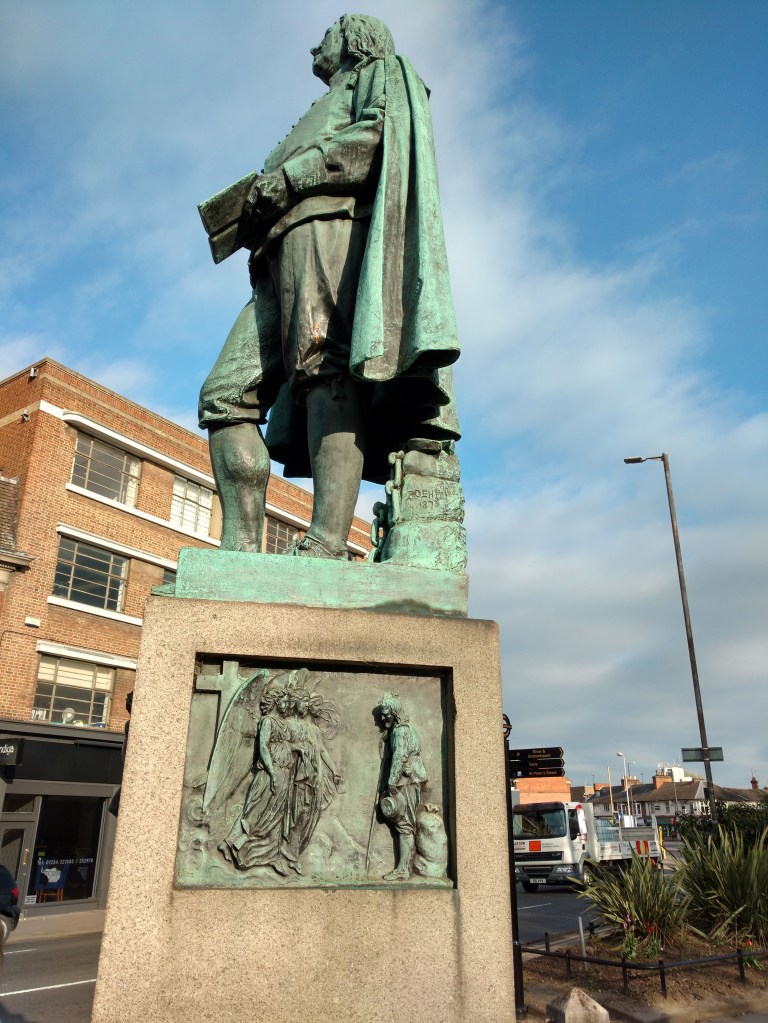
John Bunyan was arrested in 1660 and spent twelve years in jail for preaching about Christ. While a prisoner, along with other works he wrote Pilgrim’s Progress, one of the most read and beloved works in the English language.

Bedford UK 7/04/2017 A bronze statue of English Christian writer John Bunyan stands on St Peter’s Green, Bedford, England. The statue was sculpted by Sir Joseph Edgar Boehm, it was erected in 1874.

Three centuries later, in 1963, Martin Luther King Jr. wrote Letters from a Birmingham Jail.

Over his 27 years of imprisonment 1962-1989, Nelson Mandela wrote his Conversations with Myself, collected and published in 2010.

Any of these three, and so many others, could have broken under the stress of what they and their families suffered. Instead, like Paul almost two thousand years before, they used their time as prisoners to write.

Karis penned hundreds of pages from her own “imprisonment” in hospitals. Even when she could be home, unable to get away from the prison of her ailing body, she wrote precious words of encouragement to others.

Did you know that thousands of people have used Covid lockdown to write to write? Publishers have been flooded by this work. Last year, 100,000 titles were added to Amazon every month! Many artists created master works or composed music.

Covid lockdown hasn’t been fun or easy. For many people, it’s been awful. But people around the world have grown closer to the Lord through their time of isolation. Like Paul, they have responded with prayer and worship. Through the Holy Spirit’s empowering, they have boldly (Acts 1:8) shared the Gospel. They have taken time to reflect on their lives and have seen God’s faithfulness and presence with them even in their loneliness.

On this blog, since we entered “Ordinary Time,” we’ve traveled with Peter, Paul and others through Luke’s account of the Holy Spirit at work during the often stressful and painful earliest days of the Christian church. Luke concludes his book with the brief description of Paul imprisoned in Rome cited above. Did his life end there? Many people think not; see, for example, https://www.biblestudytools.com/bible-study/topical-studies/the-fourth-missionary-journey-what-happened-to-paul-after-acts.html.

There’s so much we don’t know, because it wasn’t written down or what was written wasn’t preserved. I take from this once again the encouragement to Remember and Tell what we notice God doing in our world, in our generation. I’m waiting for your story! How has God been at work in your life? I would love to know!

Let’s take for ourselves these words Paul wrote to Timothy from prison in Rome: God has not given us a spirit of fear and timidity, but of power, love, and self-discipline. So never be ashamed to tell others about our Lord. … Keep a clear mind in every situation. Don’t be afraid of suffering for the Lord. Work at telling others the Good News, and fully carry out the ministry God has given you (2 Timothy 1:7-8, 4:5).

But God longs to heal us

Acts 28:17-31 Three days after Paul’s arrival [in Rome], he called together the local Jewish leaders. … “I asked you to come here … to explain that I am bound with this chain because I believe that the hope of Israel—the Messiah—has already come. … The Holy Spirit was right when he said to your ancestors … ‘the hearts of these people are hardened … their hearts cannot understand, and they cannot turn to me and let me heal them’” [Isaiah 6:9-10; Matthew 13:15].

I’m at Fall Run Park with two-year-old Caleb, his baby sister Talita in a pack on my chest. Caleb dawdles on footbridge #5, watching the brook gurgle over the rocks. I turn to see whether he’s coming. He looks up and runs as fast as he can to catch up to us, trips over a stone in the path and falls flat. In an instant he is up and running to me, shrieking, blood running down his arms and legs. Others on the path reach out, wanting to help.

But it’s to me he runs, even as I jog the few steps back toward him, wanting to care for his wounds, but even more, to comfort his heart. I know I can do this. The bond between us is strong. In that moment, there is nothing else in my mind and heart but the desire to restore my grandson to the joy he had been experiencing moments before.

Shutterstock: Maria Sbytova

“Turn to me and let me heal you.” Can you hear the yearning in the Father’s heart? He sees me in need, and he has the solution to my needs. His arms are open wide, an expression of love and compassion and tenderness on his face. He longs to care for me. But I am afraid and shrink away. It was my own fault I fell. I am so clumsy! I should have—so many things! Not run so fast, watched where I was running, not dawdled in the first place . . . I am ashamed. I turn to others, seeking comfort and protection and healing in other places, inadequate places. The Father’s face falls, even while his arms still stretch toward me. His heart is broken because I have listened to other voices, telling me I must heal myself before I can turn to him—something I can do no better than my two-year-old grandson could care for himself.

The Father’s invitation still stands, his arms open wide, hope and love on his face. Turn to me and let me heal you.